

Is Crypto Gambling Legal? A Country-by-Country Guide for 2026
Crypto gambling legality varies dramatically by country. Most places don't prosecute individual players — but the rules differ. Here's the current picture for 20+ countries.
Published June 19, 2026· Updated August 27, 2026· By Evan Kowalski
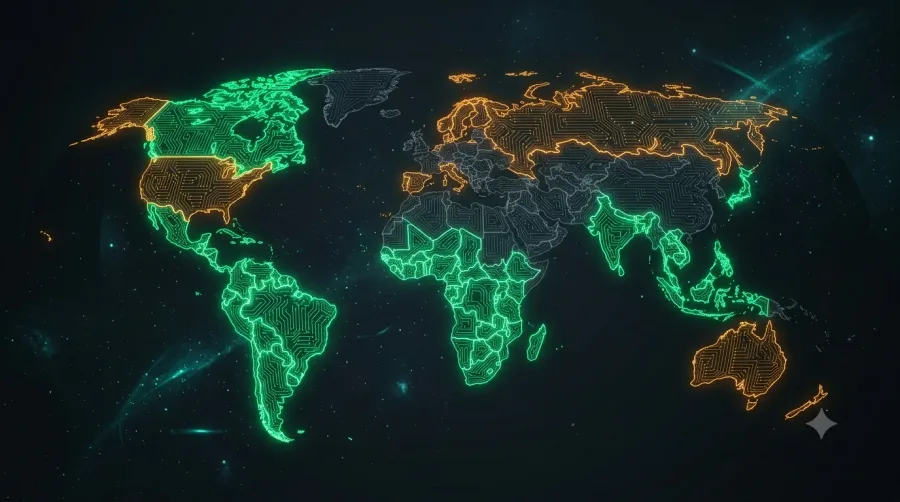
The legal question around crypto gambling has two separate parts that most guides conflate: is it legal for the operator to offer these services, and is it legal for you to play? The answers often differ.
In most jurisdictions, gambling enforcement focuses on operators — companies that run casinos, accept deposits, and take a house edge. Players are rarely prosecuted for using offshore gambling sites, even when those sites operate in a legal grey area.
This guide covers the player-facing picture: what your actual risk is in each major market in 2026. This is not legal advice; gambling laws change and vary by specific circumstance. When significant money is involved, consult a lawyer familiar with your jurisdiction.
The General Rule
Across most of the world, playing at an offshore casino with a valid Curaçao or similar license falls into one of three categories for players:
- Technically legal — the jurisdiction has no law that prohibits player participation in offshore gambling
- Grey area — the law is ambiguous, and enforcement against individual players is effectively zero
- Technically restricted — the law nominally prohibits playing, but prosecution of individual players has never or rarely happened
Crypto adds a layer: because transactions move peer-to-peer without a bank intermediary, many jurisdictions have no mechanism to block individual players even when they nominally want to. The UIGEA in the US, for example, targets payment processors — not wallets sending crypto directly.
Country Guide
The countries below cover the general pattern. A handful of markets have rules unusual enough to warrant their own full breakdown: Cyprus, Indonesia, Thailand, the UAE, China, and South Korea.
United States — Grey Area
The US is complicated in exactly the way you’d expect from a federal system.
Federally, the Unlawful Internet Gambling Enforcement Act (UIGEA) prohibits financial institutions from processing gambling payments[1] — but targets banks and payment processors, not individual players. The Wire Act restricts interstate online gambling, but its application to crypto is untested.
At the state level, online casino gambling is legal and regulated in eight states as of 2026: New Jersey, Pennsylvania, Michigan, West Virginia, Connecticut, Delaware, Rhode Island, and Maine (though Maine’s market hasn’t fully launched).[2] Players in these states can use licensed state platforms.
For offshore crypto casinos: no US individual has ever been federally prosecuted solely for playing at an offshore gambling site. Operators take the legal risk; players historically have not. Crypto’s peer-to-peer transactions don’t pass through the payment processors UIGEA targets.
Some operators run separate US-facing products under a sweepstakes model rather than real-money gambling — Stake.us, for example, is a social casino (no real-money wagering) rather than a regulated version of Stake.com. Others block US players entirely.
United Kingdom — Restricted (Operator Level)
Online gambling is legal and well-regulated in the UK through the UK Gambling Commission.[3] However, UK-facing operators must hold a UKGC license — and virtually no offshore crypto casino does.
This means no-KYC crypto casinos are technically operating illegally by accepting UK players. The UKGC’s enforcement focuses on operators: domain blocking, fines, and license challenges. Individual UK players face no criminal penalties for using unlicensed offshore sites, and no UK player has been prosecuted for this.
The practical picture for UK players: you can access these sites (with some ISP-level blocking that a VPN bypasses in seconds), your deposits work, withdrawals work, and your legal risk is negligible. But your consumer protections are weaker than with a UKGC-licensed operator.
Australia — Grey Area
Australia’s Interactive Gambling Act 2001 (IGA) prohibits offshore operators from offering certain gambling services to Australians.[4] The law technically covers players too — but has zero known individual prosecutions in 25 years of enforcement.
Enforcement focus is entirely on operators. Australian players who use offshore crypto casinos face no practical legal risk. The country’s blocks on offshore sites are routinely bypassed by players using VPNs.
Canada — Generally Legal
Federal law in Canada doesn’t explicitly prohibit Canadians from playing at offshore gambling sites. Each province regulates its own gambling, with most allowing offshore play without penalty.
Ontario launched a regulated online gambling market with licensed operators.[5] Players in Ontario can legally use regulated platforms; offshore crypto casinos exist in a grey area that the government largely ignores.
Germany — Regulated, Crypto Murky
Germany launched a new federal online gambling framework in 2021 under the Interstate Treaty on Gambling (GlüStV 2021), overseen by the GGL.[6] Licensed operators must comply with strict rules including €1 per spin stake limits, restricted bonus structures, and mandatory player identification.
Offshore crypto casinos without German licenses operate in violation of operator-level rules. Player-level enforcement is light — the law’s focus is on operators and their advertising, not individual players.
Crypto payments add uncertainty: the regulatory treatment of crypto deposits and withdrawals by unlicensed operators isn’t clearly defined, and enforcement against individual players hasn’t materialized.
Netherlands — Regulated, Newly Enforced
The Netherlands launched its regulated online gambling market in 2021 (KSA licensing).[7] The KSA actively blocks unlicensed operators and pursues enforcement more aggressively than most European regulators.
For players, individual-level prosecution remains minimal. But the Netherlands is one of the stricter European markets for operator enforcement.
Sweden — Regulated
Sweden’s regulated gambling market (Spelinspektionen)[8] has strict licensing requirements and restricts offshore operators. Players can access offshore sites; individual prosecution doesn’t happen. Swedish banks may block gambling transactions, which crypto bypasses.
Finland — Grey Area, Monopoly Ending
Finland’s gambling monopoly (Veikkaus)[9] has dominated the market for years, but Finland’s parliament approved legislation in December 2025 ending Veikkaus’s monopoly over online betting, slots, and casino games — a licensing system for private operators is being phased in from 2027, though Veikkaus retains the lottery and physical slot-machine monopoly. Offshore gambling by Finnish players is technically in a grey zone, but individual prosecution is effectively zero.
Brazil — Recently Regulated
Brazil passed comprehensive sports betting and online gambling regulation (Lei 14.790/2023) in 2023, effective from January 2025,[10] with the licensing regime still being implemented in 2025–2026. The country’s emerging regulatory framework is focused on operator licensing; offshore play continues in a transitional grey area for players.
India — State Dependent
Gambling law in India falls to individual states, creating a patchwork. Online gambling is explicitly legal in Goa, Sikkim, and a handful of others. Most states prohibit it under old laws that predate online gambling. Since August 2025, the federal Promotion and Regulation of Online Gaming Act (PROGA) also bans all real-money online games nationally, but explicitly targets operators and facilitators — not players.[11]
Crypto gambling adds additional complexity: India has historically had a difficult regulatory relationship with cryptocurrency, though crypto itself is legal as of 2026.
Japan — Restricted
Online gambling (except specific legal forms like horse racing) is broadly prohibited in Japan under Penal Code Articles 185–186, which criminalize gambling itself, not just operating it.[12] Player-level prosecution used to be rare for offshore casino use — that changed in 2025, with record arrests and a new law asking Curaçao and Anjouan to help block Japanese users. See our full breakdown: Is Crypto Gambling Legal in Japan? The 2025 Crackdown.
New Zealand — Grey Area
New Zealand’s Gambling Act 2003[13] prohibits offshore operators from targeting NZ residents, but individual player prosecution is unknown. New Zealanders routinely use offshore crypto casinos without consequence.
South Africa — Grey Area
South Africa’s National Gambling Board[14] focuses on operator licensing; no offshore casino holds a South African license. Individual players using offshore sites face no practical enforcement. Crypto transactions bypass banking restrictions.
The Tax Question
Gambling winnings are taxable in some jurisdictions (the US taxes gambling income; the UK doesn’t). Crypto adds a layer: in many countries, converting crypto gains from gambling to fiat may trigger capital gains tax separately from gambling tax.
This isn’t a gambling regulation issue but it’s a real one. If you’re winning significant amounts at crypto casinos, understand how your country treats gambling winnings and crypto transactions for tax purposes. The answer varies significantly and matters for large wins.
The Practical Summary
For most players in most countries: the realistic legal risk of playing at a reputable, licensed offshore crypto casino is low to negligible at the individual level. Operators bear the regulatory risk; players rarely face consequences.
The genuine risks are different:
- Consumer protection — less recourse than regulated domestic operators
- Payment disputes — harder to resolve without regulatory backing
- Tax obligations — country-dependent and real for large wins
Pick casinos with multi-year track records and clear withdrawal policies. The legal risk for the casino choosing you as a player is their problem. The practical risks for you as a player are largely about whether the casino actually pays.
See our full no-KYC casino reviews for the platforms we trust based on track record and transparency.